
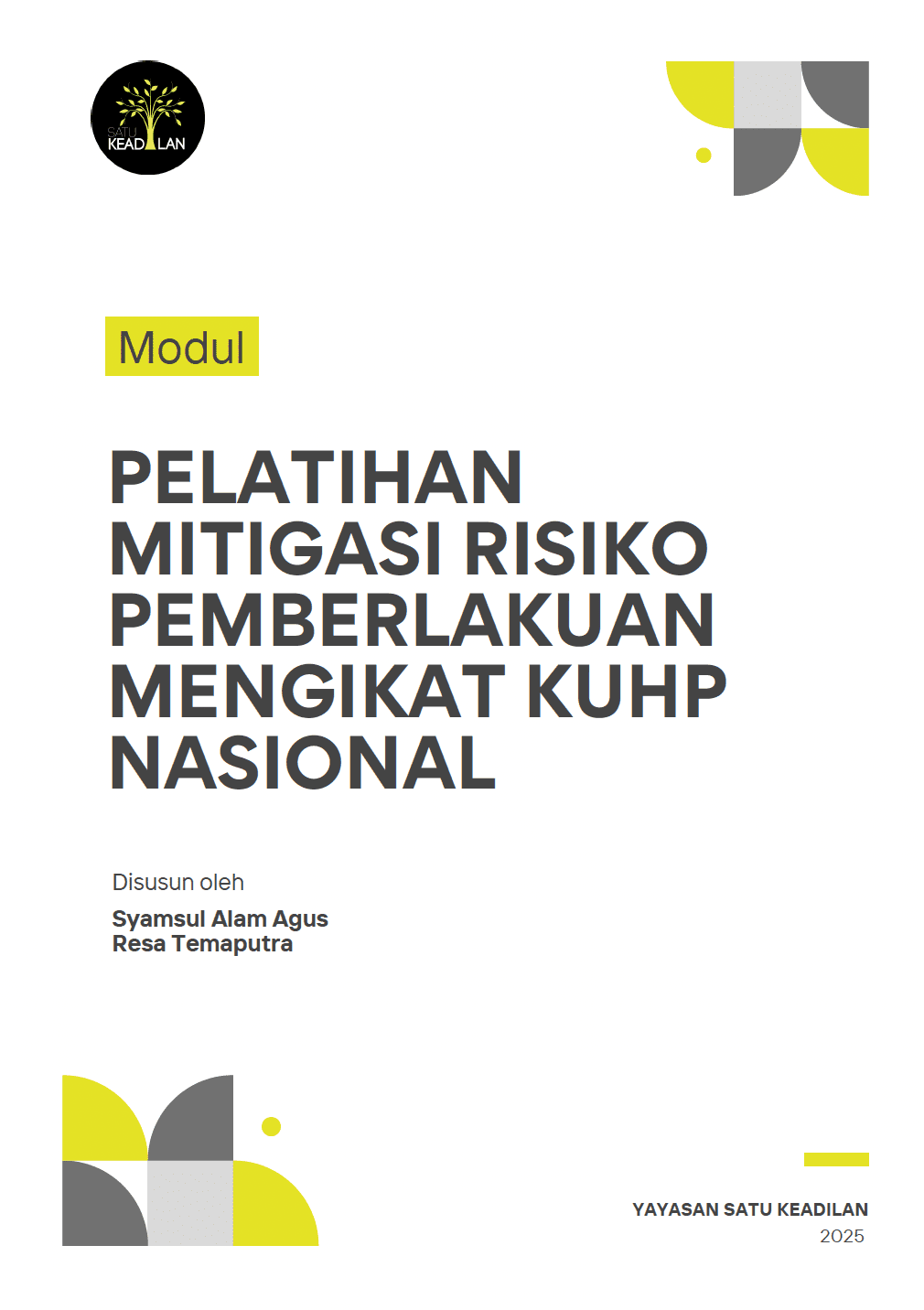
Developed by Yayasan Satu Keadilan with support from Search for Common Ground Indonesia, the guideline was implemented through advocacy and risk mitigation training addressing the impact of the new Penal Code on freedom of religion or belief, tolerance, and the human rights of vulnerable groups. The module had been tested and applied through trainings in Bogor, Bandung, and the Solo region.
The guideline, written in Bahasa Indonesia, provides clear and practical guidance to help communities navigate the implications of Indonesia’s new Penal Code. It outlines the relevant legal framework, identifies provisions that pose risks to vulnerable groups, and introduces human rights based approaches to risk mitigation. The guideline also explains the use of advocacy and legal aid mechanisms while strengthening digital security practices. Together, these components support communities in understanding their legal environment and responding to potential risks in an informed and coordinated manner.
The guideline applies a participatory and adult learning approach that combines case studies and simulation based exercises. Through this process, participants learn to identify relevant legal provisions and community specific risks, assess their likelihood and potential impact, and develop context appropriate mitigation strategies. The module guides participants in designing short and long term action plans, supported by practical tools for planning, coordination, and monitoring. It also promotes stronger digital safety practices, including secure management of online content and digital accounts. Supporting manuals and toolkits assist communities in developing safety and security standard operating procedures tailored to their specific needs under the new Penal Code.
Guideline Structure
- Session 1 Introduction
Introduces the background and rationale of the new Penal Code, profiles vulnerable groups in Indonesia, and outlines key risks and challenges they face. - Session 2 Security Risk Identification
Examines the impact of the new Penal Code through case studies and group discussions to identify local specific risks. - Session 3 Risk Mitigation Strategies
Presents human rights based approaches to risk mitigation, the roles of civil society organizations and local government actors, the development of security protocols, and internal policy recommendations for legal and human rights practitioners. - Session 4 Implementation and Monitoring
Focuses on mitigation action planning, performance indicators, regular evaluation processes, and stakeholder collaboration, including the use of technology to support monitoring and response. - Session 5 Practical Training
Provides hands on exercises through simulations of security incidents, emergency response planning, and role play scenarios to strengthen engagement with law enforcement. - Session 6 Evaluation and Follow Up
Guides participants in assessing learning outcomes, documenting recommendations, and designing sustainable capacity building plans. - Session 7 Closing Session
Summarizes key lessons, encourages reflection, and provides space for questions and clarification.
Overall, the guideline is designed to be both informative and action oriented, enabling communities to understand legal risks under the new Penal Code and build resilience through coordinated, locally grounded, and rights based responses.
You must be logged in in order to leave a comment