

When planning peacebuilding interventions, the direct role that different communication channels can play in transforming conflict and achieving social change is seldom acknowledged. Here, I want to introduce a framework for both researchers and practitioners, which highlights the potential of Communication for Social Change (CSC) in post-conflict settings through the use of participatory media. The study from which I have developed this framework is based on the experience of a participatory video (PV) project conducted in the Rift Valley of Kenya after the 2007/2008 Post-Election Violence (PEV), when the country underwent a period of intense ethnic violence.
What I present here shows how these types of media productions can contribute to re-establishing relationships and creating a shared understanding of the conflict, while building a vision of an interconnected future among opposing groups. It also brings to light the link between CSC and conflict transformation theory. This is useful for those involved in peacebuilding work to begin to recognise the important role that CFS can play in this field. In addition, I propose a practical model that peacebuilding organisation can keep in mind when incorporating participatory communication in their programming.
Project background
The Kenyan PEV, which lasted from December 2007 to February 2008, saw over a thousand people losing their lives and hundreds becoming displaced. In the Rift Valley, where my research took place, one of the main causes attached to the political conflict was the historical dispute over land between the two ethnic groups. The fighting was primarily in the hands of the youths. At the end of the violence, conflict specialist NGO Mercy Corps set up a ‘sports for peace’ project to bring together youths from different tribes to take part in conflict management and peace dialogue processes through football. In order to evaluate this activity, the NGO made use of PV through an activity facilitated by UK-based organisation Insightshare. In the videos, beneficiaries tell, and at times act, their stories of how – thanks to the project – their feelings and behaviour towards members of the rival tribe changed from hatred and violence to forgiveness and/or acknowledgement of the wrongs done during the conflict. At the end, two screenings of the final videos were also organised with the aim of creating a space for debate
The participatory videos developed through Mercy Corps work were not conceived by the organisation as peacebuilding materials, but simply as instruments to assess the impact of the NGO’s programme. However, I chose to analyse this PV exercise under a reconciliation lens to determine whether or not these media productions have in reality also served as tools for re-uniting the wider communities affected by the conflict.
Bridging theories
Shapiro (2006) describes what needs to be targeted in conflict interventions to achieve social change:
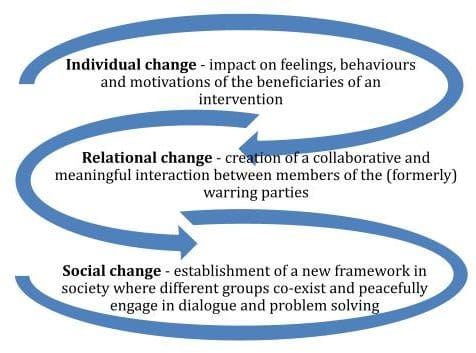
- Changing individuals: this encompasses shifts in attitudes, perceptions, feelings, behaviours and motivations of the beneficiaries of an intervention.
- Changing relationships: change at this level occurs when interventions are designed to create a collaborative and meaningful interaction between members of the (formerly) warring parties, which results in the improvement of inter-group relations.
I believe that, from a communication perspective, these types of change can be achieved when people participate in the production of a media story that allows them to both reflect upon and become aware of their situation, as well as to share their experience and create an understanding among other groups.
This is emphasised also in White’s (2003, p. 98) work, which recognises as the main effects of PV those of: ‘catalysing conversation’ among individuals who would normally not interact with each other; ‘increasing individuals’ observation of events’, as people tend to observe their reality more carefully when they have to choose what to film; and ‘instilling a sense of responsibility for relevance’, as the film-maker acknowledges their task to show to the viewers a particular story or fact.
Evaluation framework
From these and other scholarly considerations, I developed a framework of analysis for the project that looked at the impact of the video productions in the light of the two dimensions of change that Shapiro (2006) identifies in conflict interventions – the personal and relational ones – and of an additional resulting dimension that I have created, addressing social change. Below is a visualisation of this framework:
The answers I gathered from my interviewees showed how PV had an effect on each dimension of change:
Individual change – the PV activities seem to have strongly contributed in instating participants’ confidence in re-establishing peace, in helping them identify themselves as agents of change, and also in guiding them in the discovery of new skills.
“And I decided by my own, it was something that was very tiresome, I decided by my own to be that peacemaker, to educate people, to let people know the fruits of staying or being peaceful, by educating, by telling them, by pressing to them to abandon their own traditional way of living, and to change their current way of addressing issues”.
Relational change – the PV activities have established harmony among those who had worked together in the mixed-tribe workshops. A constructive dialogue was initiated between the young members of the different tribes who took part in the video making, and among those who watched the videos at the public screenings. An understanding was created of the situation of both victims and perpetrators and relationships that were broken began to heal.
“After the election, we were split up with our friends, but after coming and watching the videos, I felt that there was something happening from that. Peter was saying that, ‘These people have killed my parents, and I’m not going to actually sit with them’. So from watching the video, I saw that Peter is saying that things have happened, but it comes a time that we have to stay together. I felt pleased to see Peter greeting the people who had not been on the same thoughts as him. So I felt happy, seeing people saying that we should come together and be like the way were living before. I felt touched. Because during the period when we were fighting, I didn’t believe that there was going to be peace anymore”.
“All of us who watched were shocked ‘cause we were also feeling the sorrow inside us. Some were actually crying from viewing the images. When we went later and sat down and discussed about it, we saw that our hearts had calmed down because we had seen that it wasn’t only us who were hurt.”
Social change – A sense of unity as citizens of one Kenya arises from people’s answers. Thanks to the power shifts resulting from this new perception, members of different communities began to engage in a dialogue and one of the tribes invited the opposing one to come together and talk. This represents a contribution towards the foundations that are needed to begin to build a new social fabric.
“We’ve poured our hearts, we’ve talked and it brought some healing to our past. And even after watching the movies, even as they were being made, as they were coming up in the stories, it made me realise that reconciliation can be achieved. Because everyone went that extra mile to bring things back to normal.”
Building on from these outcomes, I developed a model that effectively shows how CSC projects can encompass activities that address conflict transformation. In particular, it recognises how changes at the individual, relational and social level are brought about within this process:

The CSC in Conflict Transformation Model provides a useful paradigm for peace studies researchers and peacebuilding practitioners to understand the functioning of CSC in post- violence contexts, exemplifying how the introduction of a catalyst such as PV can initiate processes of conflict transformation that lead to a wider social change. By creating a structure for the role of participatory media and their effect on conflict transformation, this model is also guidance for practitioners to experiment with the application of participatory media projects in their peacebuilding interventions.
To read the full study: Baú, V. (2014) Building Peace through Social Change Communication. Participatory video in conflict-affected communities, Community Development Journal; doi: 10.1093/cdj/bsu025
Other useful readings:
Baú, V. (2014) Telling Stories of War through the Screen. Participatory video approaches and practice to bring peace in conflict-affected contexts, Conflict & Communication Online, Vol. 13, No. 1,
Figueroa, M. E., Kincaid, D. L., Rani, M., & Lewis, G. (2002). Communication for Social Change: an integrated model for measuring the process and its outcomes, Communication for Social Change working paper series. New York: Rockefeller Foundation, consulted on 10 February 2009: http://www.communicationforsocialchange.org/pdf/socialchange.pdf
Rodriguez, C. (December 2004). Communication for Peace: contrasting approaches. The Drum Beat, No.278, http://www.comminit.com/drum_beat_278.html
 Valentina Baú is a Senior Research Fellow at Western Sydney University (Sydney, Australia). Both as a practitioner and as a researcher, her work has focused on the use of communication in international development. Valentina has collaborated with different international NGOs, the United Nations and the Italian Development Cooperation across the Global South. Her doctoral research has looked at the use of Communication for Development in Peacebuilding, particularly through the use of participatory media. Click here to access her academic webpage.
You must be logged in in order to leave a comment